
Introduction
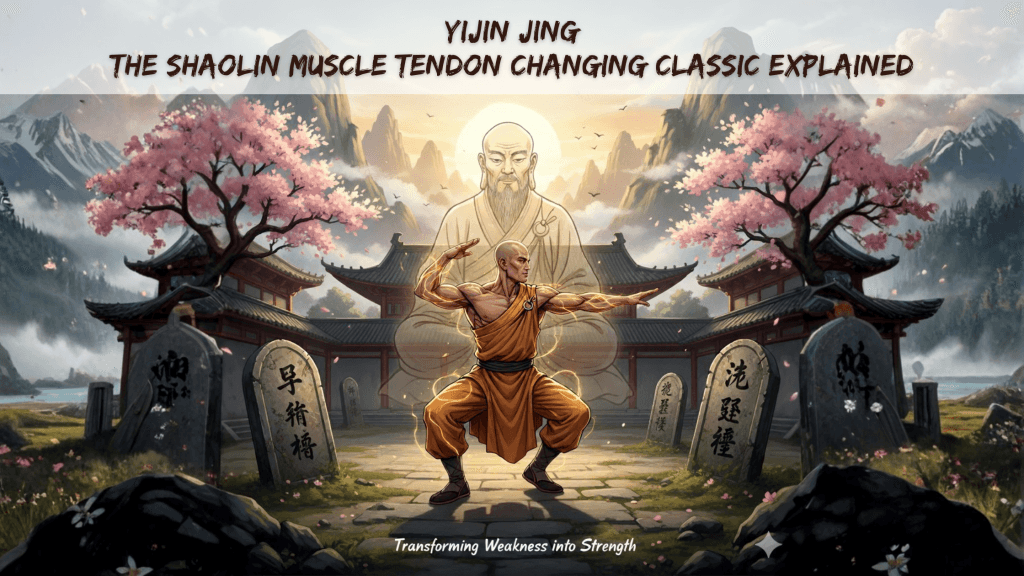
The Yijin Jing, or Muscle Tendon Changing Classic, is one of the most treasured ancient practices of Shaolin Kung Fu. Believed to have been created by the great Zen master Bodhidharma during the 5th–6th century, this exercise system is said to strengthen both body and mind — transforming weakness into power through discipline and energy cultivation.
Origins of Yijin Jing
The term Yijin Jing (易筋经) translates as:
Yi (易) – change or transform
Jin (筋) – tendons and sinews
Jing (经) – classic or method
Together, it means “The Classic of Changing Tendons and Sinews.”
According to legend, Bodhidharma introduced Yijin Jing to the Shaolin Temple after observing the monks’ poor physical condition. Drawing inspiration from Indian martial art Kalaripayattu and Yoga, he developed a set of movements to improve flexibility, strength, and internal energy (Qi). Over time, these exercises became the foundation for the physical and spiritual training of Shaolin monks.
The Lost Teachings and Rediscovery
It is said that the original Yijin Jing manual was written in an Indian language, which made it difficult for Shaolin monks to fully understand. Over generations, much of its original meaning was lost.
Legend tells of a monk who sought to translate the text, believing it held deeper wisdom beyond combat techniques. With the help of an Indian monk named Pramati, only parts of the manuscript could be deciphered.
While the exact number of original exercises remains uncertain, many scholars agree there were 18 movements inspired by the 18 Arhats (enlightened disciples of Buddha). However, the most widely accepted version today includes 12 postures, as described in the 1858 text “Essential Technique of Guarding Life.”
These 12 postures are sometimes referred to as the “Twelve Fists of Bodhidharma” in southern martial arts traditions.
The Five Core Principles of Yijin Jing
Every practitioner of Yijin Jing follows five essential rules designed to harmonize body, breath, and mind.
1. Quietness
“Like lake water reflects the moon, a calm spirit allows energy to move inside the body.”
Stillness of mind allows Qi (life energy) to flow freely and deeply.
2. Slowness
“To flex muscles deeply, extend fully, and move Qi and blood (Xue), slow movements are required.”
Deliberate slowness enhances focus, flexibility, and strength.
3. Extension
“Each movement must be brought to its maximum.”
Full extension awakens the tendons and opens the body’s energy pathways.
4. Pause
“Efficiency comes through waiting and keeping tension for a long time.”
Pausing during each movement builds endurance and inner power.
5. Flexibility
“Limbs and trunk must be extended so that blood and energy can circulate.”
Flexibility ensures vitality, balance, and long-term joint health.
Yijin Jing and Shaolin Kung Fu Training
In Shaolin martial arts, Yijin Jing is more than physical conditioning — it’s a spiritual discipline. By refining the tendons and sinews, practitioners also refine their Qi (energy), leading to better health, stamina, and focus.
Regular practice of Yijin Jing improves posture, strengthens muscles, and enhances flexibility, making it a cornerstone of Shaolin internal training (Neigong).
Learn more about Bodhidharma’s history and Shaolin Qigong and internal energy cultivation.
The legend of a Zen master: Life and teachings of Bodhidharma
Conclusion
The Yijin Jing, or Muscle Tendon Changing Classic, remains one of the most profound treasures of Shaolin heritage. Combining the wisdom of Zen, Yoga, and martial arts, it offers a timeless path toward strength, balance, and enlightenment.
Whether practiced for health, martial skill, or spiritual growth, the legacy of Bodhidharma’s teaching continues to inspire generations of seekers worldwide.
LATEST PROTOCOL GUIDES
Practical Guides. Real Results
DIGITAL



Start Your Protocol
Small, deliberate steps create massive transformation over time.